Healthcare has traditionally been cautious about change—and for good reason. Patient data is sensitive, systems are complex, and downtime is not an option. But in 2026, the pressure to modernize has reached a tipping point.
Medical applications that once ran on local servers are now being re-evaluated for cloud environments. The reason is simple: legacy systems can no longer keep up with the demands of modern healthcare.
This is not just a technology upgrade. It is a transformation in how care is delivered, data is accessed, and systems are managed.
Why Legacy Healthcare Systems Are Holding Organizations Back?
For years, hospitals and healthcare providers relied on on-premise systems to manage electronic health records, imaging platforms, and clinical applications. These systems offered control, but they also created limitations.
As data volumes grow and patient expectations evolve, legacy infrastructure struggles to scale. It becomes harder to integrate systems, share information across departments, and support remote care.
Even basic operations like accessing patient data across locations can become inefficient, slowing down decision-making and impacting care quality. Healthcare organizations are now recognizing that outdated infrastructure is no longer sustainable.
The Cloud Advantage in Modern Healthcare
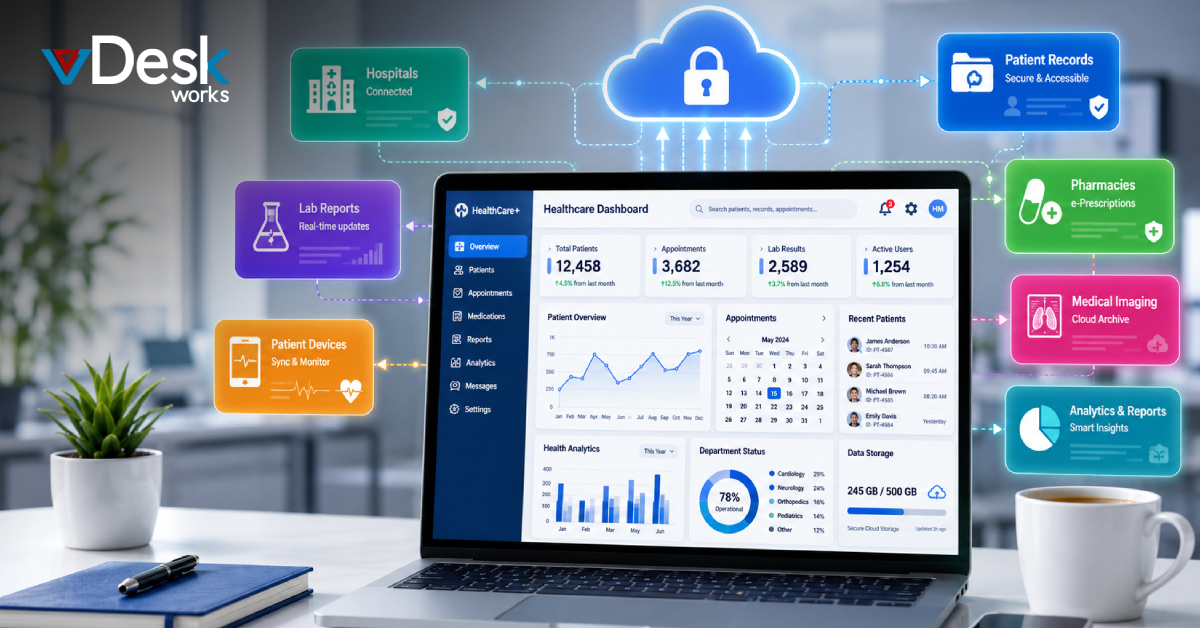
Moving medical applications to the cloud addresses many of these challenges at once. It enables healthcare providers to access data in real time, collaborate across locations, and scale systems based on demand.
Cloud environments also reduce the burden of maintaining physical infrastructure. Instead of managing servers and hardware, organizations can focus on improving patient outcomes and operational efficiency.
Another major advantage is accessibility. Clinicians can securely access applications and patient data from different locations, improving coordination and response times.
Beyond efficiency, cloud adoption opens the door to advanced capabilities like analytics and AI, helping organizations extract more value from their data.
The Challenges No One Can Ignore
Despite its benefits, moving medical applications to the cloud is not without risk. Healthcare systems are complex, and migration requires careful planning to avoid disruptions.
One of the biggest challenges is data migration. Transferring years of sensitive patient information while maintaining accuracy and compliance is a high-stakes process.
Security and compliance are equally critical. Healthcare data is governed by strict regulations, and any misstep can lead to serious consequences. Ensuring that cloud environments meet these standards is essential.
There is also the challenge of legacy compatibility. Many healthcare applications were not designed for cloud environments, requiring updates or re-architecture before migration.
And perhaps most overlooked is change management. Staff must adapt to new systems and workflows, which can slow adoption if not handled properly.
Why a Phased, Strategic Approach Wins?
Successful cloud adoption in healthcare is not about moving everything at once. It requires a phased approach that prioritizes critical applications while maintaining continuity of care.
Organizations must evaluate which systems are ready for migration, which need modernization, and which should remain on-premise for specific use cases.
This hybrid strategy allows healthcare providers to transition gradually, reducing risk while still gaining the benefits of cloud technology.
It also ensures that patient care is never compromised during the process.
VDI is the Missing Layer in Healthcare Modernization
While much of the focus is on applications and data, one critical layer is often overlooked—the user environment.
Doctors, nurses, and administrative staff need consistent, secure access to systems, regardless of location or device. This is where VDI plays a transformative role.
VDI delivers complete desktop environments through the cloud, ensuring that healthcare professionals can access their tools and data without dependency on specific devices.
This is particularly valuable in healthcare settings where mobility, speed, and reliability are essential. It ensures that systems remain accessible even in dynamic or high-pressure environments.
Why vDeskWorks VDI Fits Healthcare Needs?
For healthcare organizations modernizing their IT infrastructure, vDeskWorks VDI provides a solution designed for both performance and control.
vDeskWorks centralizes desktops, applications, and data access within a secure cloud environment. This reduces reliance on local machines and ensures consistent access across departments and locations.
From a security perspective, it keeps sensitive data within controlled environments, helping organizations meet compliance requirements while reducing the risk of data exposure.
It also simplifies IT management. Instead of maintaining multiple devices and configurations, healthcare IT teams can manage everything from a single platform.
For distributed healthcare systems, vDeskWorks ensures that clinicians and staff can access their workspaces instantly, improving efficiency and supporting better patient care.
The Future of Healthcare is Built on Flexible Infrastructure
The move to the cloud is no longer optional for healthcare organizations—it is inevitable. The question is not whether to adopt the cloud, but how to do it effectively.
Medical applications are at the center of this transformation. Their migration must be handled with precision, balancing innovation with reliability.
VDI for healthcare adds an essential layer to this transformation, ensuring that users can interact with these systems seamlessly and securely.
In the end, the goal is not just modernization. It is creating a healthcare environment that is faster, more connected, and better equipped to serve patients.
And that future is undeniably cloud-driven.
 Emma Carson