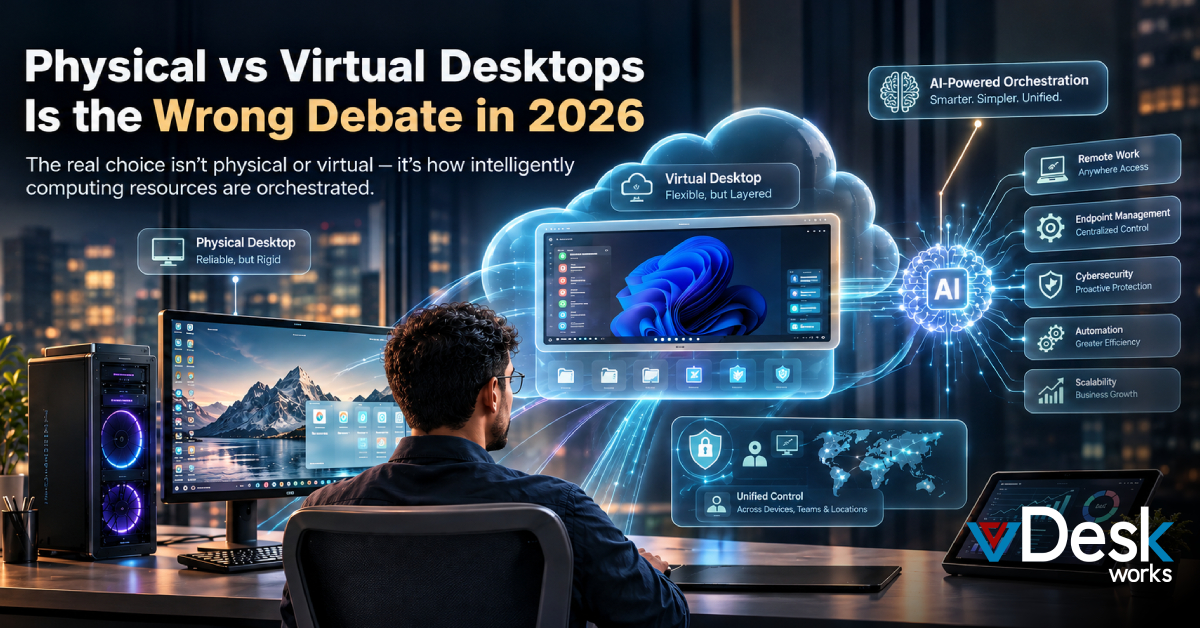
For years, businesses have been stuck asking the same question: Should we stick with physical desktops or move to virtual desktops?
It sounds like a logical comparison. One is familiar and hardware-based. The other promises flexibility and remote access.
But in 2026, this debate is outdated.
The real shift isn’t choosing between physical and virtual desktops—it’s moving beyond both toward a model built for how work actually happens today.
Physical Desktops: Reliable, but Rigid
Physical desktops are what most businesses grew up with. Each employee has a device, data lives locally, and performance is predictable.
There’s a reason they’ve lasted this long—they work.
But they come with limitations that are increasingly hard to ignore.
They are tied to a location. If the device isn’t physically accessible, neither is the work. Supporting remote teams becomes complicated, requiring VPNs, additional security layers, and constant troubleshooting.
They also demand ongoing maintenance. Hardware upgrades, repairs, and replacements are unavoidable costs. IT teams must manage each device individually, which becomes inefficient at scale.
Even security becomes fragmented. Data is stored across multiple endpoints, increasing risk and making centralized control difficult.
Physical desktops offer control—but at the cost of flexibility.
Virtual Desktops: Flexible, but Layered
Virtual desktops were introduced to solve many of these challenges.
By hosting desktops in a centralized environment, businesses gained the ability to deliver workspaces remotely. Employees could access their desktops from any device, anywhere, as long as they had an internet connection.
This was a major step forward.
Security improved because data stayed within controlled environments. IT teams gained centralized management, making updates and monitoring easier. Scaling became more efficient compared to buying new hardware for every employee.
But virtual desktops introduced a new kind of complexity.
They rely on layered infrastructure—servers, virtual machines, networks, and access protocols. Managing these layers requires expertise, time, and constant optimization.
Performance can also vary depending on bandwidth and resource allocation. And while they reduce hardware dependency, they don’t eliminate infrastructure—they just shift it elsewhere.
Virtual desktops solved access.
They didn’t solve complexity.
The Core Problem: Both Models Are Infrastructure-First
Physical desktops and virtual desktops may seem like opposites, but they share the same foundation.
Both are built around infrastructure.
Physical desktops rely on distributed hardware. Virtual desktops rely on centralized infrastructure. But in both cases, IT teams are still responsible for managing systems, resources, and environments.
That’s the real issue.
Modern businesses don’t need better infrastructure management. They need less infrastructure to manage.
The New Requirement: Work Without Boundaries
Today’s workforce operates differently.
Employees work across locations, devices, and time zones. Teams scale quickly. Projects evolve constantly.
This creates new expectations:
Workspaces must be accessible instantly
Performance must be consistent everywhere
Security must be centralized, not device-dependent
Scaling must happen without planning delays
Neither physical nor traditional virtual desktops fully meet these expectations.
Virtual Desktop Changes the Model Entirely
Virtual Desktop is not just another version of virtual desktops.
It removes the complexity that both physical and virtual models carry.
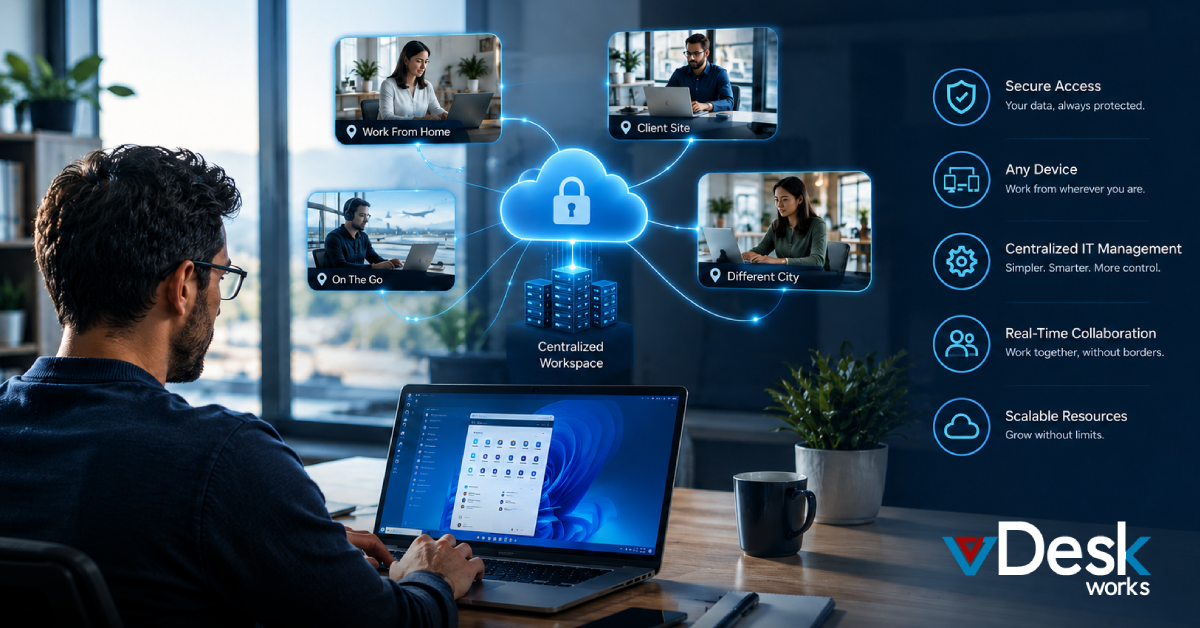
Instead of managing devices or layered infrastructure, Virtual Desktop delivers a complete desktop environment directly from the cloud—fully configured, always available, and consistent across users.
There is no dependency on specific hardware. No need to manage virtual machines or backend systems manually.
Users simply log in—and their workspace is there.
This is the key difference.
Virtual Desktop is not infrastructure-first. It is experience-first.
From Devices and Systems to a Unified Workspace
The biggest shift Virtual Desktop brings is simplicity.
IT teams no longer need to manage individual devices or complex virtual environments. Everything is centralized into a single, unified platform.
Updates happen once and apply everywhere. Security policies are enforced centrally. Performance is consistent across locations.
For users, the experience becomes seamless.
For IT, the workload becomes manageable.
Why vDeskWorks Virtual Desktop is the Practical Evolution?
For organizations ready to move beyond outdated models, vDeskWorks Virtual Desktop delivers a modern alternative built for real-world business needs.
vDeskWorks removes the dependency on both physical hardware and complex virtual infrastructure. It provides fully managed cloud desktops that are accessible instantly from any device.
This ensures consistency across teams, whether they are in-office, remote, or distributed globally.
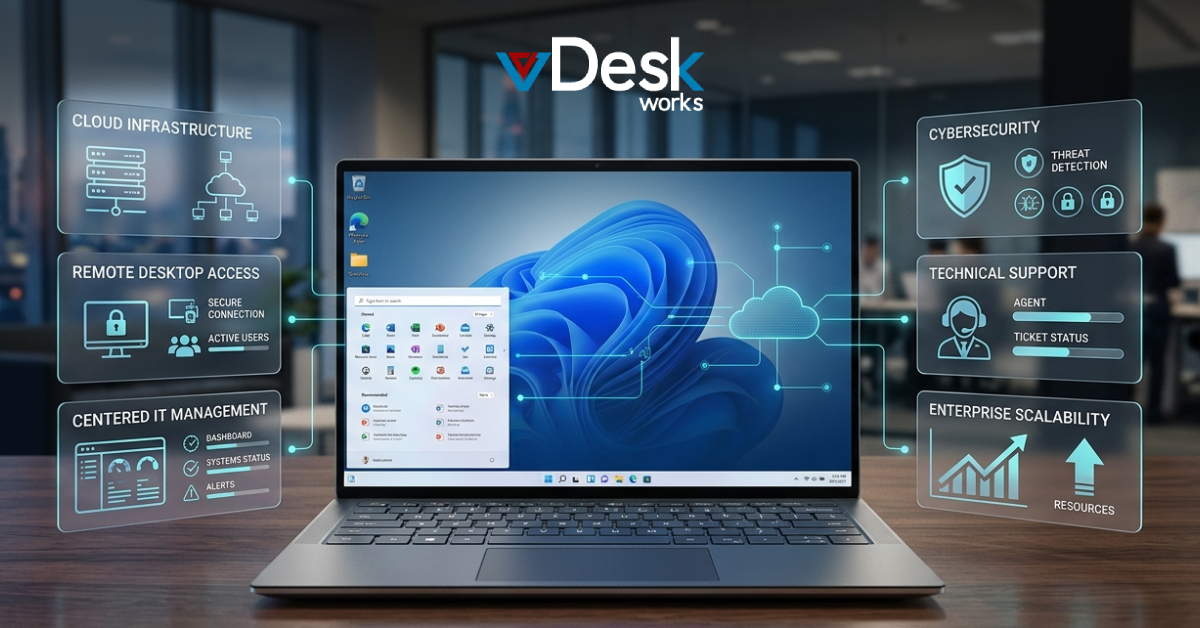
From an IT perspective, vDeskWorks Virtual Desktop centralizes everything. Deployment, management, security, and scaling are handled from a single platform, reducing operational overhead and improving visibility.
It also enables true scalability. New users can be onboarded in minutes, without purchasing hardware or configuring environments.
Most importantly, it simplifies the entire workspace experience—something neither physical nor traditional virtual desktops fully achieve.
The Future Isn’t Physical or Virtual—It’s Cloud-Native
The question is no longer whether physical desktops are better than virtual desktops.
That comparison belongs to a previous generation of IT.
The future is cloud-native.
It’s about delivering workspaces that are flexible, secure, and instantly available—without the burden of managing infrastructure.
 Emma Carson